
How to value a property in Australia: a buyer’s agent’s method
Everyone will give you a number.
The agent has a price guide. The bank has a valuation. Three different websites have three different estimates, and your brother-in-law who bought in 2019 has a very confident opinion. What none of them give you is the working. Just the answer, delivered with varying levels of certainty and almost no explanation of how they got there.
Valuing a property is not complicated. It is just detailed, and most people skip the details because the details are boring. This is how I do it.
First, decide which number you actually want
There are four different numbers floating around and people mix them up constantly.
Market value is what a willing buyer and a willing seller would agree on, with neither under pressure and both properly informed. This is the number you want.
The agent’s price guide is a marketing tool. It is set to attract buyers to a campaign. Sometimes it is accurate. Sometimes it is deliberately conservative to build competition. It is not evidence.
A bank valuation is a lender’s assessment of security, not of value. Banks are protecting themselves against a forced sale, so bank valuations tend to sit at or below market. A low bank valuation is not proof you overpaid.
An online estimate is a model output. It reads sales data and property attributes and produces a figure. On a standard house in a suburb with plenty of recent sales, it will often be reasonable. On anything unusual, recently renovated, or in a quiet market, it can be a long way off, because a model cannot walk through a house.
Everything below is about establishing market value.
Every property is land plus building
Start here, because it shapes everything after it.
A property is two things. The land, and whatever is sitting on it. Land is the part that appreciates. The building depreciates from the day it is finished, regardless of how good the tapware is.
That split matters because two properties can look wildly different and be worth almost the same, or look identical and be worth very different amounts, depending on how the land and building components stack up.
The good news is that Australian suburbs make this easier than it sounds. Suburbs get built out in eras. Walk through a development that went up in the 1970s and you will find clustered land sizes, similar frontages, similar build years and a fairly narrow range of original floor plans. The clustering is doing a lot of the work for you before you have started.
Step 1: Build the comparable set
The comparable sales method is what professional valuers use for residential property and it is what you should use too. The principle is simple. If three similar houses nearby sold recently for $620,000, $635,000 and $645,000, a fourth similar house sits somewhere in that neighbourhood.
Simple to describe. Easy to do badly.
Match the land first. Get your comparable land sizes as close to the subject property as you can. Same street is ideal. Same pocket works. And be careful with suburb boundaries – a main road can split a suburb into two genuinely different markets, and treating both sides as one comparable set will wreck your numbers before you have adjusted anything.
Match the era. A 1975 brick veneer and a 2015 build on the same land size are not comparable, even at the same address range. Different construction, different layout logic, different buyer.
Sale recency depends on which way the market is heading. This is the part most guides get wrong by giving a fixed rule.
If the market is flat, six months of sales is fine. You can go further back if you have to.
If the market is rising or falling, you need the freshest evidence you can get, and anything older than three months needs to be treated cautiously.
If the market is moving quickly, an old sale is not just less useful. It is actively misleading, because it will tell you the market was somewhere it no longer is.
So before you look at a single comparable, work out the direction. Are values in that specific pocket rising, flat or falling? That decision sets your window.
Aim for three to six genuine comparables. Three tight ones beat six loose ones. If you cannot find three, widen the geography before you widen the time window – a similar house one suburb over last month usually tells you more than the house next door eighteen months ago.
Step 2: Configuration is not floor space
This is the one almost nobody covers properly, and it is where a lot of amateur valuations quietly go wrong.
Two houses can both be advertised as three bedrooms, two bathrooms, two car spaces. On paper, identical. One has 40 more square metres of internal living area, a proper connection between kitchen and living, and a floor plan a family can actually use. The other has three bedrooms where the third is a converted study you reach through the laundry.
Configuration is a label. Floor space and layout are the product.
Two properties with the same bedroom count and materially different living areas are not comparables. They are two different products that happen to share a description. And layout versatility matters as much as raw area – an awkward 160 square metres will often sell for less than a well-designed 145.
This is also exactly where automated estimates fall over. A model can read a bedroom count off a listing. It cannot tell you the floor plan does not work.
Step 3: Condition, quality and fitout
Picture two houses side by side. Same land, same era, same configuration, same street. One has been fully renovated. One has not been touched since it was built.
They will not sell for the same figure. Not close.
So for every comparable, you need to know what condition it was in at the time of sale. Not what condition it is in now. Look at the listing photos from the actual campaign, not the current street view.
What you are assessing:
Kitchen and bathrooms, and whether the work was done properly or done cheaply
Structural elements – roof, stumps, footings, external walls
Services that cost real money to replace: electrical, plumbing, drainage
Fitout quality, which is where a renovation either holds its value or does not
A cosmetically pretty renovation over unresolved structural problems is worth less than an untouched original in sound condition. Buyers who have been through a building and pest report know this. Models do not.
Step 4: Build a range, not a number
I will say this plainly. There is no single number.
Two very similar houses in the same street will sell for $710,000 and $730,000 within weeks of each other. Different buyers, different motivations, different Saturday. Anyone who hands you one precise figure is telling you about their confidence, not about the property.
The output should always be a range. And the range has to be built, not guessed.
Here is how you build it. Do not just find like-for-like comparables. Deliberately find properties above and below your subject.
Slightly inferior comparables set your floor
Slightly superior comparables set your ceiling
Clearly superior and clearly inferior properties confirm you are in the right band at all
Your subject should land between the slightly-inferior and slightly-superior results. If it lands outside that, one of your assumptions is wrong, and it is worth finding out which before you write an offer.
Truly identical comparables do not exist in houses. Apartments and townhouses in the same block are the exception, and they are gold when you can get them. For everything else, bracketing is the substitute for identical – and it is a far more honest method than pretending you have made precise dollar adjustments for a bigger kitchen.
Step 5: Interrogate every outlier
When a sale in your set lands well outside the band, it is telling you something. Your job is to work out what, and then decide whether to keep it or throw it out.
Sold unusually low. Work through the physical factors first:
Main road frontage
High voltage power lines or an easement across the block
Backing or facing a commercial precinct
Facing a cemetery
Directly adjacent to commission housing, or a neighbour with no street appeal
Immediately next to a school, which sounds like a selling point until you have tried to park there at 3pm
None of these are fatal. All of them shrink the buyer pool, and a smaller pool produces a lower price. That discount is real and it will still be there when you sell.
If none of those apply, look at the property itself. A structural defect found during the inspection period will often produce a price reduction rather than a collapsed sale, because vendors decide a discount beats going back to market. That sale is not a market signal. It is a repair bill wearing a disguise.
Then there are the circumstances that never appear in the data. Deceased estates. Separations. A vendor who bought unconditionally elsewhere and has a settlement date bearing down on them. Any of these can produce a result that looks like a market movement and is not one.
You should also exclude, or at minimum flag, the sales that were never arm’s length in the first place:
Transfers between family members
Mortgagee-in-possession sales
Related party transactions
Off-market deals to an adjoining neighbour who wanted the land, not the house
Sold unusually high. Usually one of two things – a tightly held pocket that consistently outperforms the broader suburb, or a school catchment.
There is also a scenario I see more often than I would like. A selling agent from outside the area prices against the whole suburb rather than the specific pocket and gets it wrong. Sometimes that means a property sells under what it should have. Occasionally it means a buyer paid over. It is not common. It is not rare either.
The selling agent is worth calling about any outlier. Just remember who they act for. Their explanation is a lead to chase, not a conclusion to accept.
A real example: the renovated house that sold for less
Here is how all of this looks in the wild. Two houses in Strathpine, in Brisbane’s north, both sold in 2026. On paper they were about as close to identical as houses get:
Both three-bedroom, one-bathroom
Both on 607 square metres
Both around 85 square metres of internal living space
Same suburb, two blocks apart
One was completely original – old kitchen, never touched. The other had an updated kitchen and newer floor coverings. Every instinct says the updated one sells for more.
It sold for less. By $45,000. The original went for $985,000. The updated one went for $940,000.
The difference was location. The updated house backed onto a carpark and sat next to a school. That penalty came out of the same buyer pool the property was competing for, and it wiped out everything the renovation added – and then some.
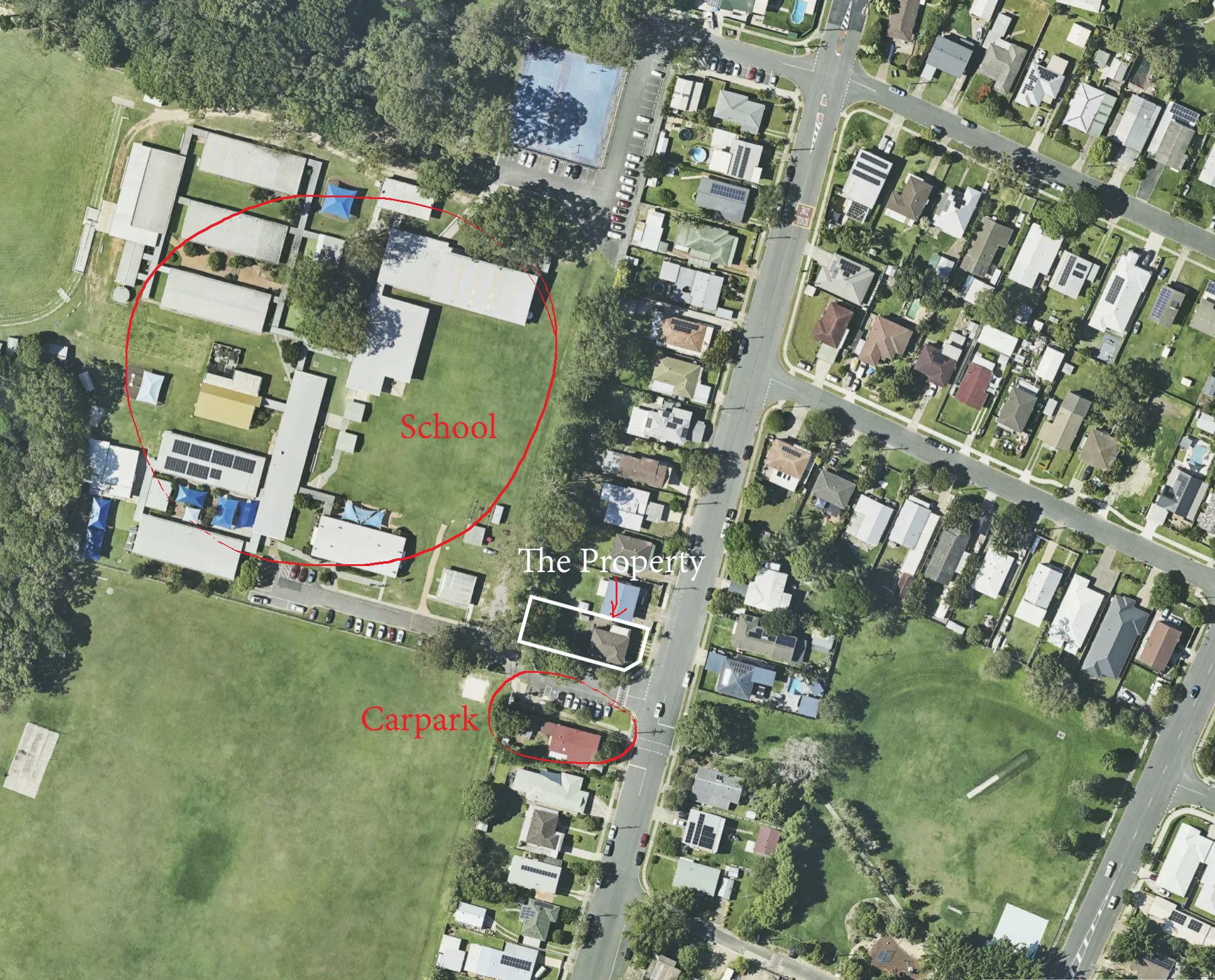
Updated house backed onto a carpark and sat next to a school
Here is the part that makes it worse, and it is exactly why market direction matters. The original sold in February. The updated house sold in June. Brisbane values kept rising over those four months – the city was still climbing while Sydney and Melbourne had already turned. So the later sale had a rising market working in its favour and a renovation on its side, and it still came in lower. Time-adjust the two to the same month and the real location penalty is larger than the raw gap, not smaller.
This is also what an automated estimate cannot do. Feed those two properties into an online model and it returns close to the same figure for both – same land, same size, same configuration. It cannot see the updated kitchen, and it cannot see the carpark. It hands you one confident number and misses the two things that set these houses apart.
Drop that $940,000 sale into a comparables report without asking why it sold where it did, and you would have under-valued the original by tens of thousands. That is the whole reason you interrogate outliers rather than averaging them in.
Things that quietly move value
Beyond the physical property, a handful of factors move price and are easy to miss because they do not appear in a listing.
Zoning and development potential. Two identical houses, one on a block that can be subdivided or has higher-density zoning. Very different value, and the difference is invisible unless you check the planning scheme.
Easements and covenants. A sewer or drainage easement can restrict where you build. A covenant can restrict what you build. Both sit on title and both affect price.
Orientation. In the southern states, a north-facing rear yard may command a genuine premium. In the north, the calculation flips and western sun becomes a liability.
Slope. A steep block costs materially more to build on and to landscape. Compare a sloping site to a flat one and you are not comparing like with like.
Overlays. Heritage overlays restrict what you can change. Flood and bushfire overlays affect insurance cost, lending, and increasingly, buyer appetite.
Frontage and shape. A 600 square metre block with 20 metres of frontage is worth more than a 600 square metre battleaxe. Land size is not land value.
Apartments and townhouses follow different rules
If you are valuing strata, most of the above still applies but the weighting changes completely.
Land value is diluted across the block, so the building and the scheme matter far more. Comparables within the same complex are extremely valuable – it is the closest thing to a genuinely identical comparison you will ever get.
But you also need to look at things that never come up with houses:
Floor level and aspect, which can move value substantially within one building
Owners corporation financials and the sinking fund balance
Any building defect history, which can devastate value and take years to resolve
Strata levies, because high levies reduce what a buyer can pay
Whether the block is investor-heavy or owner-occupier-heavy
Two apartments with the same floor plan in the same suburb can be worth very different amounts if one sits in a well-run building and the other in a scheme facing a special levy.
Three mistakes worth avoiding
Do not value on price per square metre. It gets recommended a lot and it is borrowed from commercial property, where it makes sense. Residential value does not scale linearly with floor area. A 300 square metre house is not worth twice a 150 square metre house on the same land. Use it as a rough sense check across a tight comparable set if you must, never as a method.
Do not use the suburb median. A median tells you the midpoint of what sold. If a batch of new townhouses settled last quarter, the median moves without a single existing house changing in value. Cotality’s own index methodology uses hedonic regression specifically to strip out the compositional bias that medians carry. If the people who publish the data will not rely on the median, neither should you.
Check contract dates, not settlement dates. Public sales data flows from settlement. A property showing as sold in June may have gone under contract in March on a long settlement. In a flat market that is a rounding error. In a moving market it means you are pricing where the market was a quarter ago.
The short version
Match the land. Match the era. Look past the bedroom count to the floor space and the layout. Assess the condition as it was on the day of sale. Build a range by bracketing with slightly superior and slightly inferior evidence. Chase down every outlier until you know why it is an outlier. Check the planning scheme and the title before you commit to a number.
It takes a few hours to do properly on a single property. Which sounds like a lot until you compare it to the cost of being $40,000 wrong.
Frequently asked questions
Does renovating always increase a property’s value?
No. A renovation only adds value once everything else is equal, and it rarely is. A better kitchen can be completely outweighed by a location penalty – a busy road, a carpark, a school next door. In one 2026 Strathpine sale, an updated house sold for $45,000 less than an original one on the same land size and floor area two blocks away, because the updated house backed onto a carpark and a school. Condition matters, but it sits below land and location in what moves the number.
How many comparable sales do I need?
Three genuine comparables are usually enough to set a range, provided you also identify slightly superior and slightly inferior properties to bracket it. Quality beats quantity every time.
How recent do comparable sales need to be?
It depends on market direction. In a flat market, six months is workable. When values are moving in either direction, stick to three months and treat anything older with caution. Confirm the contract date rather than the settlement date, since the two can be a full quarter apart.
Should a property valuation be a single number or a range?
A range. Very similar properties routinely sell tens of thousands of dollars apart depending on who turns up on the day. A single figure implies a precision that does not exist.
Are online property value estimates accurate?
They are model outputs and they perform reasonably on standard properties in areas with plenty of recent sales. They struggle with anything unusual, recently renovated, or in a market with thin transaction volume, because a model cannot assess condition, layout quality or a location drawback.
Why is a bank valuation lower than the price I paid?
Bank valuations assess the property as loan security, not as market value. Lenders are protecting against a forced sale scenario, so they tend to be conservative. It does not automatically mean you paid too much.
Why did one comparable sale go for so much less than the others?
Usually a physical factor that shrinks the buyer pool – main road, power lines, adjacent commercial or institutional use – or a defect found during the inspection period, or a vendor under time pressure. Establish which before treating it as evidence of value.
What is the difference between a valuation and an appraisal?
A valuation is a formal assessment by a certified practising valuer and carries professional liability. An appraisal is an agent’s opinion of likely selling price, provided free as part of winning a listing. They are not the same thing and should not be treated as such.