
Most bank economists expect the Reserve Bank to hold the cash rate at 4.85% when it meets on 8 December. The reason is an awkward pair of numbers. Inflation rose to 4.9% in the year to October, and unemployment rose to 4.9% in the same month. Raise interest rates again and the jobs market takes another hit. Hold, and underlying inflation stays well above target.
The RBA has one lever, and right now these 2 numbers want it pulled in opposite directions.
The short version
Inflation is moving the wrong way. Headline inflation is 4.9% and underlying (trimmed mean) inflation is 3.8%. Both rose in October, and both are above the RBA's 2-3% target.
So is unemployment. At 4.9%, it's the highest since October 2021, after 43,500 jobs went in a single month.
The biggest price jumps aren't the kind interest rates reach. Petrol rose 32.5% and electricity 25.2% over the year. Raising interest rates slows spending, but it doesn't change the world price of oil.
The rate rises are working, starting with the usual things. 5 hikes this year have already hit jobs and house prices. Capital city home values fell 8.1% in 7 months, the fastest decline in more than 40 years. Inflation is usually the last thing to move.
The banks are signalling. NAB cut its 3-year fixed rate by 0.28%, more than a standard 0.25% RBA cut. Banks rarely do that unless they expect the next move to be down. Forecasts aren't guarantees, though.
The pain is concentrated. On a $600,000 loan, this year's rises add about $485 a month. The newest borrowers carry most of it. Outright owners with savings earn more interest.
The CPI doesn't count mortgage repayments. They were taken out in 1998. Rent is still in.
If you're buying, run the numbers at today's interest rate plus 0.5%. If a purchase only works after a rate cut, it doesn't work yet.
Two numbers, one lever
The RBA's job is to keep inflation between 2% and 3% while keeping as many Australians in work as it can. It has one main tool for both: the cash rate.
This year it has used that tool 5 times, in February, March, May, September and November. That took the cash rate from 3.60% to 4.85%, the highest level since 2008. The November decision was split: 6 board members voted to raise and 3 voted to hold. That was before October's jobs figures came out.
Those figures moved faster than the RBA expected. Its own forecast had unemployment reaching 4.9% by the end of the year. It got there in October.
What's actually pushing inflation up
The gap between 4.9% headline inflation and 3.8% underlying inflation is mostly fuel. Petrol rose 6.3% in October alone, driven by higher world oil prices. Housing costs are up 6.4% over the year: electricity rose 25.2%, new dwellings 5.1% and rents 3.5%.
Interest rates work by slowing demand. They can change how much households and businesses spend, but they can't make a barrel of oil, a power network or building materials any cheaper. Part of the inflation the RBA is fighting is the kind its tool can't reach directly.
That doesn't let underlying inflation off the hook. Even with fuel stripped out, the trimmed mean is 3.8%, and economists had expected it to stay at 3.6%. That's why the RBA hasn't stopped worrying.
The rate hikes are working, just not on petrol
It's tempting to say rate rises haven't worked because inflation is still climbing. The timing doesn't support that. The first hike was in February, and rate rises usually take a year or more to show up fully in inflation.
The early effects are where you'd expect them. Unemployment has risen 3 months in a row, from 4.5% in July. Capital city home values have fallen 8.1% in 7 months. Jobs, spending and house prices bend first. Inflation follows, and usually last.
Will interest rates go down in 2027?
On 19 November, NAB cut its owner-occupier fixed rates: 0.17% off 2-year loans and 0.28% off 3-year loans. Fixed rates are priced off where markets expect interest rates to go. A bank cutting them while the cash rate sits at an 18-year high is a signal about the next move.
The economists are saying much the same:
NAB's Taylor Nugent expects a hold, with a standard cut likely around August 2027.
CommBank expects the cash rate to stay at 4.85%, with cuts pencilled in for August and November 2027. It warns February could still be "live" if inflation stays strong.
AMP's Shane Oliver puts the risk of recession at around 40%.
Forecasts change with every data release. The next tests are November jobs data on 17 December and November inflation on 6 January.
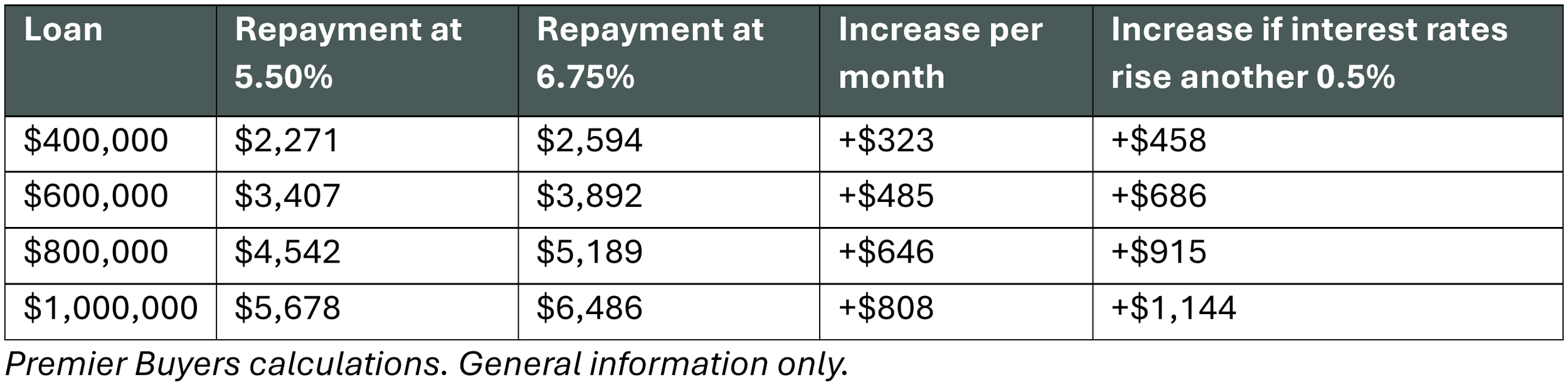
How much have mortgage repayments increased?
This table assumes all 1.25% of this year's increases were passed on to a 30-year principal and interest loan. Your own rate depends on your lender and loan-to-value ratio.
Want to run your own loan? Our mortgage repayment calculator shows today's repayment and a stress-tested one in 30 seconds.
Who barely feels a rate rise
At the 2021 Census, Australian households split roughly into thirds: 35% owned with a mortgage, 31% owned outright and 30.6% rented.
Mortgage holders feel a rate rise almost straight away, and the newest borrowers feel it most. A couple who took out their loan in 2006 may owe a fraction of what they borrowed. A first home buyer from last year is paying interest on almost the full amount.
Outright owners with money in the bank get the opposite: higher interest on their savings. So does it cancel out? The RBA tested that. It found the squeeze on borrowers outweighs the boost to savers across the economy. That's why rate rises still slow spending overall, but the cost falls heavily on about a third of households.
Where renters fit in
Rents follow vacancy rates and what tenants can afford, not the landlord's repayments. SQM's national vacancy rate rose to 1.5% in October, and annual growth in advertised rents slowed from 7.6% to 6.4% in a month. That slowdown came in the same months interest rates were going up.
There's a quirk in how the numbers are counted. Mortgage interest charges were taken out of the CPI in 1998, so higher repayments don't show up in inflation directly. Rents are still in. In the year to October, CPI rents rose 3.5%, well below fuel and electricity.
What this means if you're buying
Run every purchase at today's interest rate plus 0.5%. The table above shows what that buffer looks like in dollars.
Don't price in a rate cut that hasn't happened. If the numbers only work after 2 cuts, they don't work yet.
Softer markets change the negotiation, not the fundamentals. A falling market can shift who has the leverage on price. It doesn't turn a poor property into a good one.
Know your cash buffer. Work out how many months of higher repayments you could cover if your income changed.
Book a discovery call and we'll run the numbers on your next purchase with you.