
What actually causes a property market crash - and why Australia is not having one
General information only. Not financial advice.
Prices are falling. Cotality’s national Home Value Index peaked in March 2026 and fell 0.7% in July, the largest monthly drop since December 2022. More than three quarters of capital city suburbs went backwards over the three months to July.
So is this finally the crash people have been forecasting since roughly 2017?
No. And the difference between a correction and a crash is not a matter of wording. It is roughly 40% of your equity.
In a correction, buyers decide the price. In a crash, the bank does.
A correction and a crash are different events
A correction is a repricing. Interest rates rise, borrowing capacity shrinks, buyers bid less. Nobody is forced to do anything. If a vendor does not like the offer, they pull the property and wait.
That is precisely what is happening now. New listings are slowing in Sydney because owners are looking at weaker clearance rates and longer selling times, and choosing not to sell at all. A market where sellers can simply opt out is not a market in distress.
A crash is the opposite. The seller does not get a vote. Someone has lost their income, owes more than the property is worth, and the bank makes the decision on their behalf. Forced sales then feed on each other. Every distressed sale sets a new comparable, that comparable pushes more owners underwater, and more owners underwater produces more distressed sales.
The Reserve Bank has a name for what has to happen first.
The double trigger
RBA research paper RDP 2020-03 examined what actually drives Australian mortgage defaults. The finding was clear. Arrears track regional unemployment, and foreclosure requires negative equity on top of that. Both conditions, at the same time.
Think about why that is true:
Lose your job but hold equity. You sell normally, take your money and move on. That is a transaction, not a crash.
Underwater but still employed. You keep paying the mortgage. Nothing happens. Prices recover eventually and so does your equity.
Both at once. You cannot pay, and selling does not clear the debt. Now the bank is in charge.
That is the mechanism. Everything else is weather.
The four ingredients a crash actually needs
1. Unemployment
Not a soft patch. A break. Unemployment tripling, not drifting from 4.1% to 4.4%. Without mass job loss there is no cohort of owners who physically cannot make a repayment.
Ireland: unemployment ran at about 4.6% through the boom and peaked at 15.1% in the third quarter of 2011. Around 300,000 people, one in seven workers, lost their job by the end of 2010.
Australia: 4.4%. It has drifted higher and it is worth watching. It has not broken.
2. Lending
The single biggest predictor of how far a market falls is how badly it lent on the way up. If borrowers were assessed properly, they can absorb a shock. If they were not, they cannot.
Ireland: 100% mortgages were routine. No deposit required, and income multiples reportedly stretched to ten times salary. Borrowers had no equity buffer on day one.
Australia: since October 2021, APRA has required every borrower to be assessed at 3% above the rate they will actually pay. Interest-only lending sits around 20% of new loans. High loan-to-income and high LVR lending are both low single digits. APRA activated debt-to-income caps on 1 February 2026 as an additional guardrail. This is the most underrated fact in the entire debate.
3. Negative equity
This is the ingredient almost nobody discusses, and it is the one that converts hardship into forced sale. Without it, a distressed owner simply sells and walks away with something.
Ireland: by the end of 2010, around 47% of the value of all outstanding mortgage debt was underwater, covering roughly 31% of mortgaged properties. Arrears peaked at 12.9% of home loans 90 days overdue. Buy-to-let arrears hit 21.2%.
Australia: negative equity is rare. As at December 2025, over 90% of non-performing housing loans were still well secured, meaning the property could be sold to repay the debt in full. Arrears sit near 1.07% for non-performing loans.
APRA has already stress-tested the crash scenario. It modelled unemployment at 10%, GDP down 4% and house prices down 40%. Under the RBA’s household modelling, fewer than 4% of borrowers were at severe risk of falling behind.
4. Overbuilding
Too many homes, in the wrong places, with nobody to fill them. Not a slow year of approvals. Actual empty stock. This is the ingredient most people get backwards, because a housing shortage feels like the problem and overbuilding feels like the solution.
Ireland: 93,419 homes completed in 2006 alone, for a population of about 4.2 million. Residential construction reached almost 16% of national income. More than 200,000 homes were sitting empty by 2012, with unfinished ghost estates scattered across the countryside.
Australia: we completed 173,400 homes in the year to March 2026 against the 240,000 a year needed to meet the National Housing Accord, a shortfall of 28%. The National Housing Supply and Affordability Council put net new completions at around 232,000 over the first 18 months of the Accord against underlying demand of around 287,000. Rental vacancy is 1.3%. Rents are up 5.9% over the year.
We are not oversupplied. We are structurally incapable of oversupplying, and have been for a decade.
Ireland: what happens when all four fire at once
Ireland is the cleanest example in the modern record of every ingredient firing together.
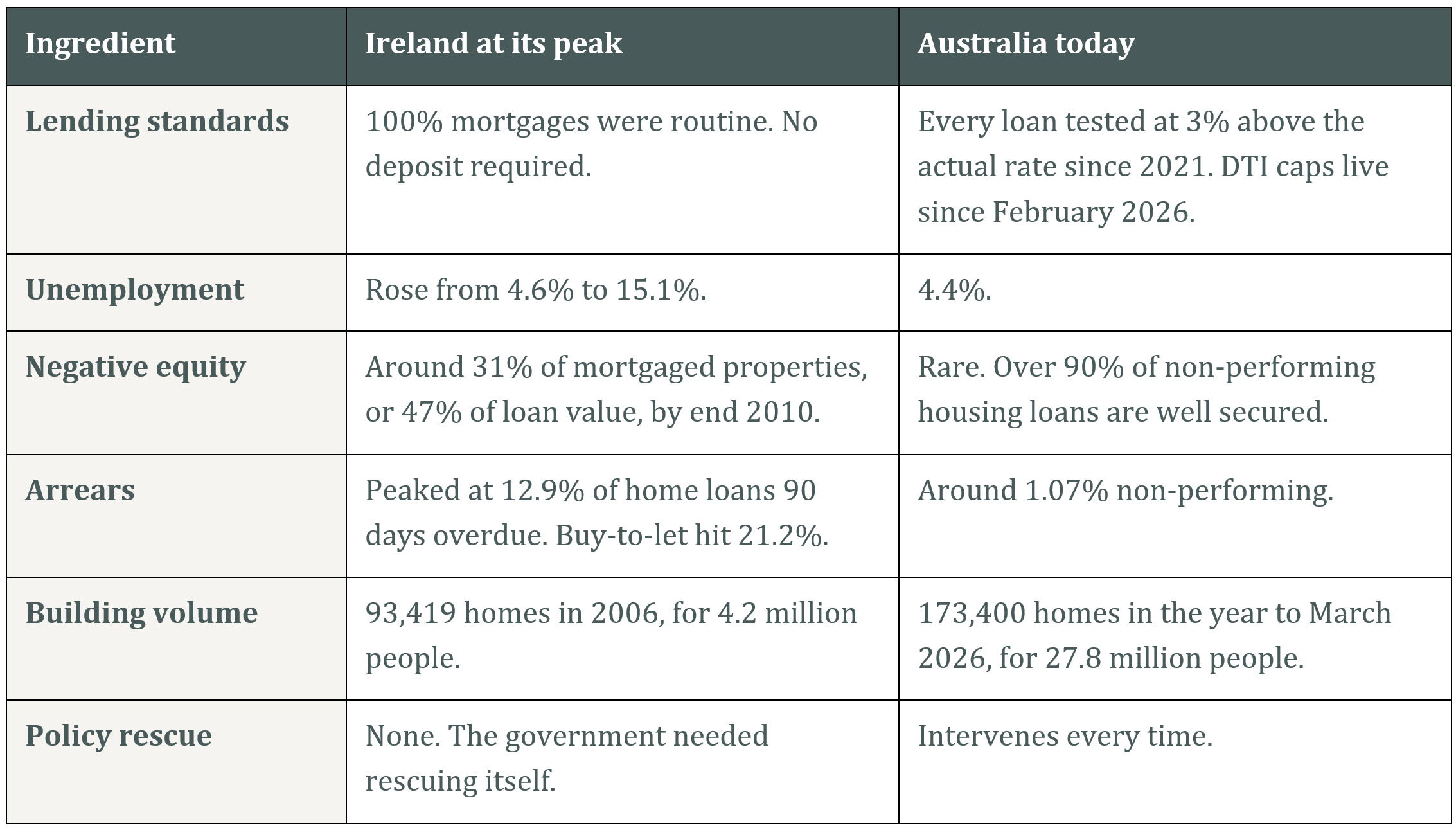
The result: Irish residential prices fell 54.4% from the 2007 peak to the 2013 trough. Dublin houses were briefly down 56%. Dublin apartments fell more than 62%.
What a crash actually looks like from the inside
The percentages do not land emotionally. This does.
Buy a Dublin apartment in February 2007 for €300,000. 100% mortgage, no deposit, because that is what banks were writing.
By 2012 the apartment is worth roughly €114,000. You still owe close to €290,000. You are underwater by about €176,000.
You work in construction, because one in five Irish jobs did at the peak. That job is gone.
Here is the part people miss. You cannot sell. Selling does not clear the debt. It converts a mortgage into an unsecured hole that follows you, because Irish mortgages are recourse loans, exactly like Australian ones. You cannot move cities for work, because the apartment will not release you. Your friends emigrate to Australia. You spend the next decade paying off a home you cannot live in, cannot sell and cannot escape.
A correction costs you money on paper. A crash costs you choices.
The comparison almost nobody makes
Ireland built 93,419 homes in 2006 for a population of about 4.2 million. That is roughly 22 dwellings per 1,000 people.
Australia built 173,400 homes in the year to March 2026 for 27.8 million people. That is about 6.2 per 1,000.
Ireland was building three and a half times more housing per person than Australia is building right now.
And Ireland still ended up with more than 200,000 empty homes by 2012 and ghost estates scattered across the countryside. We are 28% short of a target we have never once hit in any month since it was set.
But what about population? The myth worth killing
The most common Australian crash thesis runs like this: cut migration, and prices fall. It sounds obvious. The evidence says otherwise.
New Zealand. The REINZ House Price Index peaked in November 2021 and delivered the largest correction on record since 1992, around 15% nominal and 28% in real terms. During that fall, New Zealand recorded the highest net migration in its history, peaking near 135,500 in the year to October 2023 against a 25-year average of about 30,600. Record population growth and a record price fall, in the same eighteen months.
Canada. The Greater Toronto average fell from $1,334,544 in February 2022 to $1,008,968 in February 2026, a decline of 24.4%. Toronto gained 138,240 people in the year to July 2022 alone. In Ontario between 2023 and 2024, population grew 3.2% while the benchmark price fell 4.05%.
Ireland. Population rose 18.2% between 1999 and 2008, the highest rate of increase in the EU 27. Emigration only exploded afterwards, peaking at 83,000 people in 2012, five years after the market peaked.
Population reversal is not a cause of a crash. It is a symptom of one.
The economy breaks first. People leave second. The market then loses its buyer of last resort, which extends the fall. Get the order right and the whole picture changes.
Population still matters enormously for investors. It just drives rents and vacancy, not the price cycle. Australia added 412,500 people in the year to December 2025, with net overseas migration of 301,000. That is why vacancy is 1.3% and rents are up 5.9% while values are falling.
So what is actually pushing Australian prices down
Four things, and every one of them sits on the buyer side of the ledger:
A cash rate held at 4.35%, which caps how much anyone can borrow
Affordability exhaustion at the top end of Sydney and Melbourne
Uncertainty ahead of the negative gearing and capital gains tax changes
Weak buyer sentiment and roughly 11% more advertised stock
Not one of those forces anybody to sell. They simply reduce what buyers are willing and able to pay. That is the textbook definition of a correction.
Where the real risk sits, and it is not where people are looking
The national headline hides the only number that matters.
Over the three months to July 2026, the most expensive quarter of the market fell more than 3%. The cheapest quarter rose 0.3%.
Same country. Same month. Same cash rate. Opposite outcomes.
That is not a market event. It is a price-point event, and the mechanism is simple: expensive property needs a big loan, big loans are exactly what a 4.35% cash rate has strangled, and cheap property backed by 1.3% vacancy and rising rents has a floor underneath it that the top end does not.
Two investors bought in the same month. One is down 3%, one is up. The difference was not the country, the city or the timing. It was the price bracket.
The part that should actually worry you
The fall is not the damage. The recovery time is the damage.
Irish residential prices did not climb back above their 2007 peak until 2023. Dublin took even longer. Somebody who bought a Dublin apartment at the top in early 2007 was still underwater when the pandemic arrived, still underwater when their children started school, and only saw their money back around the time those children finished it.
Buy at the peak, break even when your kid starts high school. That is the actual cost of a crash.
This is why the distinction between a correction and a crash is not a debate about vocabulary. A correction takes a few percent off paper values and hands them back inside a cycle. A crash takes 16 years of your compounding, your equity release, your next purchase and your options. Nobody who lived through the Irish version describes it as a percentage.
What this means if you are buying
None of this is a forecast. Nobody credible can tell you where prices land in 18 months, and anyone who does should be treated accordingly.
What the evidence does give you is a set of filters:
Watch the mechanism, not the mood. Unemployment, arrears and negative equity are the three numbers that separate a correction from a crash. Migration headlines are noise on this question.
Understand which market you are buying into. The upper quartile and the lower quartile are behaving like different countries right now.
Borrowing capacity is the price driver. When it tightens, the assets that need the biggest loans fall the hardest. When it loosens, they recover the fastest. Know which side of that you are standing on.
Yield is the shock absorber. A property that holds itself is a property you are never forced to sell. That is the whole defence against ending up in the Dublin apartment.
The crash people are waiting for needs four ingredients. Australia currently has none of them. What Australia has is a correction that is punishing one specific end of the market and leaving the other end alone.
So if you are sitting out and waiting for a crash before you buy, it is worth being honest about what you are waiting on. Four things that are not here, and no visible mechanism that brings them.